Certifications
Credentials and courses across cloud, AI, FinOps, and sustainability.
- Certifications and courses completed
- 11
- Google Skills badges
- 17
- LinkedIn Learning certificates
- 19
01 / 17
Drag to spin · select a card to bring it forwardEarned credentials
Cloud, AI, FinOps, and sustainability credentials with issuer verification and full syllabus pages.
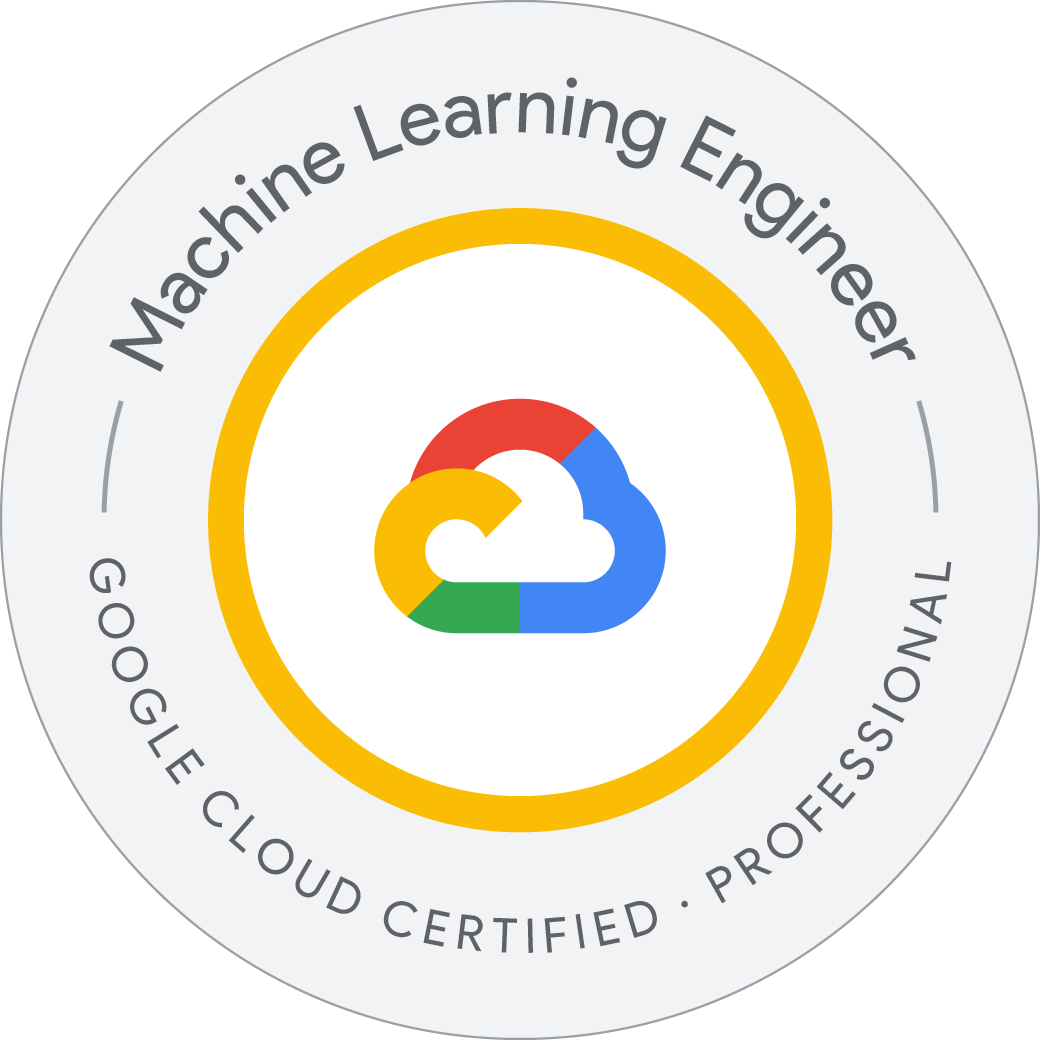
Google Cloud · Professional certification
Professional Machine Learning Engineer
- Machine learning
- Google Cloud
Amazon Web Services · Foundational certification
AWS Certified AI Practitioner
- Artificial intelligence
- AWS
In progress
The FinOps Foundation AI Value pathway and Greenpixie GreenOps for AI.
- AI Value (FinOps for AI)FinOps Foundation · Certification pathwayIn progress
- AI Value: Level 1FinOps Foundation · Training courseIn progress
- AI Value: Level 2FinOps Foundation · Training courseUp next
- AI Value: Level 3FinOps Foundation · Training courseUp next
- AI Value: Certification courseFinOps Foundation · Certification course & examUp next
- GreenOps for AIGreenpixie · Training courseIn progress
Google Skills badges
17 completion badges across machine learning, MLOps, generative AI, and responsible AI.
Google Skills profile
Create Generative AI Apps on Google Cloud
Course context
Covers prompt design and retrieval augmented generation for production oriented LLM applications, including building an LLM and RAG chat app.
ML Pipelines on Google Cloud
Course context
Introduces TFX pipeline components and orchestration, then covers repeatable pipelines, continuous training, Cloud Composer, and MLflow.
Responsible AI for Developers: Privacy & Safety
Course context
Explains practical ways to apply privacy and safety practices with Google Cloud products and open source tools.
Responsible AI for Developers: Fairness & Bias
Course context
Covers recognizing and mitigating bias, then applying responsible AI practices with Google Cloud and open source tools.
Build a Certification Study Guide: PMLE
Course context
Shows how to create a Gemini Notebook study guide and use it to practice for the Professional Machine Learning Engineer certification.
Responsible AI for Developers: Interpretability & Transparency
Course context
Explains why transparency matters to developers and engineers and presents practical ways to improve interpretability in data and models.
Machine Learning Operations (MLOps) with Agent Platform: Model Evaluation
Course context
Covers evaluation measures and methods for generative and predictive models, using Agent Platform for model selection, optimization, and ongoing monitoring.
Machine Learning Operations (MLOps) for Generative AI
Course context
Describes operational challenges for generative AI deployments and how Gemini Enterprise Agent Platform can streamline MLOps work.
Attention Mechanism
Course context
Introduces how attention focuses neural networks on relevant input and how it supports translation, summarization, and question answering.
Enterprise Search on Generative AI App Builder
Course context
Explains how organizations can make scattered internal documents and broad consumer-facing catalogs easier to search. Learners use Generative AI App Builder to add generative search to their applications.
Introduction to Vertex Forecasting and Time Series in Practice
Course context
Covers forecasting on Google Cloud from sequence-model and time-series foundations through data preparation, model development, and Vertex AI deployment. A retail example informs a final exercise in which learners build their own forecasts.
Vector Search and Embeddings
Course context
Introduces AI-powered search patterns including semantic search with vector embeddings, hybrid retrieval that combines semantic and keyword methods, and retrieval-augmented generation. Learners use Vertex AI Vector Search to build a grounded search experience and can continue with related GEAR content.
Machine Learning Operations (MLOps): Getting Started
Course context
Introduces Google Cloud tools and practices for deploying, evaluating, monitoring, testing, and automating production machine-learning systems. It describes how ML engineers work with data scientists to improve deployed models with discipline and speed.
Machine Learning in the Enterprise
Course context
Uses a case study of an ML team to examine business requirements, data governance, and preprocessing choices. Learners compare AutoML, BigQuery ML, and custom training for two example workloads.
Launching into Machine Learning
Course context
Builds from data-quality practices and exploratory analysis into AutoML, BigQuery ML, and model optimization. It also covers generalization and sampling as ways to assess models trained for custom machine-learning tasks.
Introduction to AI and Machine Learning on Google Cloud
Course context
Surveys Google's AI and machine-learning products for both generative and predictive projects. Interactive exercises connect tools across the data-to-AI lifecycle for data scientists, AI developers, and ML engineers.
Introduction to Generative AI
Course context
Introduces generative AI, common applications, and its differences from traditional machine learning. The course also points learners to Google tools for creating their own generative AI applications.
LinkedIn Learning certificates
19 course completion certificates in AI, data, cloud cost, security, and leadership, each with its original PDF.
Certificate folderDecision Intelligence
Certificate PDFCourse context
Cassie Kozyrkov introduces decision-making for leaders working in data-rich organizations. The course covers how people frame decisions, use data and technology, delegate with trust, improve organizational decision practices, and build a healthy data culture, with discussion of how AI and machine learning affect business decisions.
Course pageLLMs for Enterprise: Technical Protocols, Considerations, and Data Privacy
Certificate PDFCourse context
An introduction to enterprise large language models, technical protocols, and data privacy. Listed in LinkedIn Learning’s August 2024 AI catalog, this course was completed on August 20, 2024, with 15 minutes of course content.
Release catalogManaging AI Security Risks with ISO 27001
Certificate PDFCourse context
Apply ISO 27001 risk management to AI systems, identify vulnerabilities, and adapt ISO 27002 controls. The course connects security monitoring and compliance work with the practical challenges of AI deployments and the standards developing around them.
Course pageUse Copilot AI for Secure Work Data in Your Organization
Certificate PDFCourse context
A short course on using Microsoft Copilot with organizational data. LinkedIn Learning lists it in the April 2024 business-software catalog; the original certificate identifies Microsoft Copilot and artificial intelligence for business as its skills, with 18 minutes of course content.
Release catalogSecuring the Use of Generative AI in Your Organization
Certificate PDFCourse context
Jerich Beason’s course focuses on securing generative AI in an organization. The original certificate identifies network security and generative AI as the skills covered, with completion on July 27, 2024, and 1 hour 15 minutes of course content.
LinkedIn Learning referenceAgile Foundations
Certificate PDFCourse context
Doug Rose explains the values and principles behind an agile mindset, then connects them to teamwork and iterative delivery. Learners explore user stories, cross-functional collaboration, responding to change, popular frameworks such as Scrum and Kanban, common team roles, and exercises for improving how teams work.
Course pageIntroduction to ESG: Environmental, Social, and Governance
Certificate PDFCourse context
Fulya Kocak introduces environmental, social, and governance factors and why organizations address them. The course surveys foundational ESG concepts and risks, sustainable investing, the three ESG pillars, common measures, reporting and ratings, communication that avoids greenwashing, and skills relevant to ESG work.
Course pageUnderstanding and Prioritizing Data Privacy
Certificate PDFCourse context
Examine the role of privacy for individuals, businesses, and policymakers. The course uses concrete scenarios to connect responsible data use with organizational safeguards, the consequences of misuse, and the choices that help people protect their information.
Course pageUnconscious Bias
Certificate PDFCourse context
Recognize common forms of unconscious bias and how they influence decisions and workplace relationships. The course develops awareness of personal assumptions and offers approaches for responding to bias when collaborating with colleagues and participating in an organization.
Course pageGenerative AI: Working with Large Language Models
Certificate PDFCourse context
Explore how transformers support natural language processing and how major large language models evolved after GPT-3. The course connects model architecture, training approaches, and the contributions of different LLMs to practical choices for AI work.
Course pageExcel: Macros and VBA for Beginners
Certificate PDFCourse context
Oz du Soleil introduces Excel macros as a way to automate repeated spreadsheet tasks. Learners see when a macro is useful, record and review a basic macro, and get oriented to VBA, the Developer tab, launching macros, and common limitations such as errors and the lack of an undo action.
Course pageGPT-4: The New GPT Release and What You Need to Know
Certificate PDFCourse context
Jonathan Fernandes explores the changes introduced by the GPT-4 release. The course appears in LinkedIn Learning’s guide to generative AI and prompt engineering, and the original certificate records completion on June 12, 2023.
LinkedIn Learning referenceWhat Is Generative AI?
Certificate PDFCourse context
Build a foundation in generative AI: how it works, how models create content, and where different model families fit. The course considers changes to creative work and employment alongside ethical responsibilities and the practical use of generative tools.
Course pageReinforcement Learning Foundations
Certificate PDFCourse context
Khaulat Abdulhakeem introduces reinforcement learning concepts and the problems they can solve. The course covers core terminology, how to represent learning problems, Monte Carlo and temporal-difference methods, and extensions including deep, multi-agent, and inverse reinforcement learning.
Course pageMicrosoft Azure: Controlling Cost
Certificate PDFCourse context
Scott Duffy’s LinkedIn Learning course focuses on controlling Microsoft Azure costs. The original certificate records completion on April 4, 2023, with 1 hour 22 minutes of course content.
LinkedIn Learning referenceGoogle Cloud: Controlling Cost
Certificate PDFCourse context
Lynn Langit surveys ways to monitor and manage Google Cloud spending across compute, data, networking, and serverless workloads. Learners explore billing reports and filtered cost views, then examine budgets, alerts, quotas, payment settings, committed-use discounts, and dashboards for tracking costs.
Course pageAWS: Controlling Cost
Certificate PDFCourse context
Lynn Langit explains how to forecast and manage AWS service costs using billing tools and operational practices. The course covers consolidated billing and alerts, cost controls for services such as EC2, S3, and RDS, and architectural choices that affect spending across common cloud workloads.
Course pageData Engineering Foundations
Certificate PDFCourse context
Harshit Tyagi introduces data engineering and its relationship to data science. Learners explore data wrangling, database schemas, distributed processing, tools including Hadoop, Hive, Spark, and Airflow, and the stages of building ETL pipelines to extract, transform, load, and schedule data.
Course pageMachine Learning and AI Foundations: Classification Modeling
Certificate PDFCourse context
Keith McCormick frames classification as a central machine-learning task and compares strategies for building predictive models. The course reviews model assessment, a range of classification algorithms, and practical challenges such as imbalanced categories, interactions, missing data, overfitting, and data reduction.
Course page